

Confirm replacement of every part in the actual installation, including finishes and access constraints.
For: Designers, engineers and operations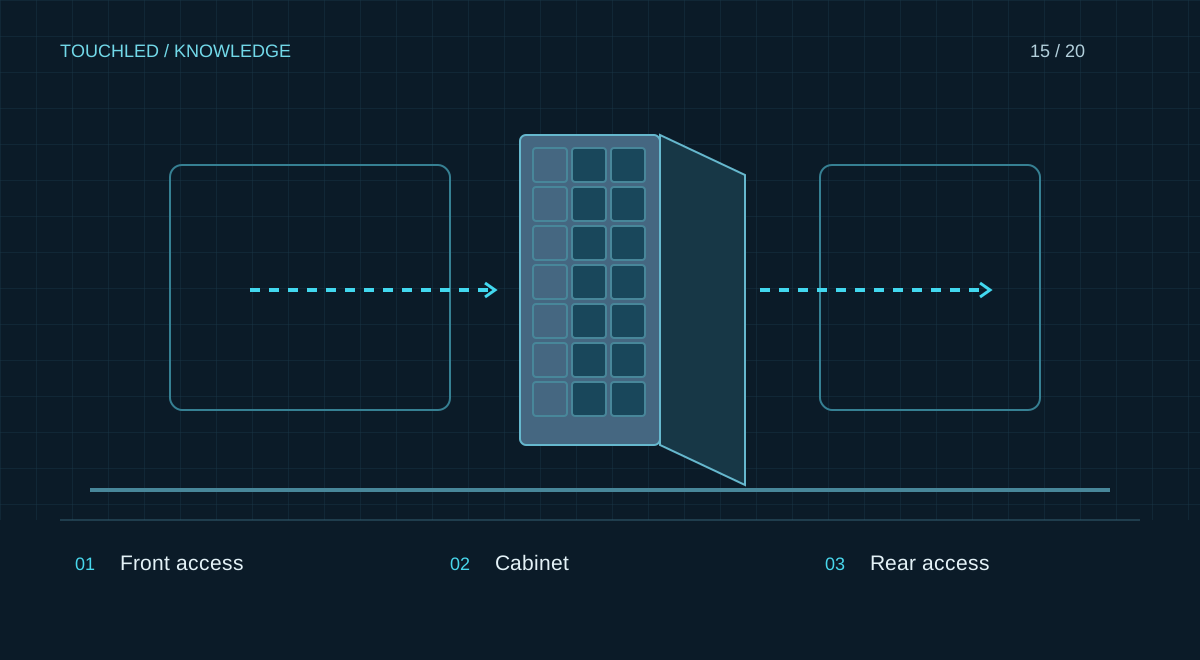
Service side is only the starting point
Front service generally means access from the display face; rear service means access from behind. For each variant establish which components can actually be removed that way. Removing an LED module does not prove that a supply, card or cable can pass through the same opening.
Request a service drawing or demonstration of the selected cabinet. Check tool requirements, hand clearance and safe support of removed parts.
Check every replaceable part
Create an access matrix and check it with decorative finishes included. Service clearance must exist on the real site, not only in a rendering.
| Part | Confirm |
|---|---|
| LED module | Removal direction, method and tool |
| Receiving card | Fixing, connector and settings access |
| Power supply | Removal and safe isolation |
| Cable | Replacement without dismantling the wall |
| Fixings | Inspection and service according to design |
Separate structural and visual design
A qualified designer assesses display mass, fixing method, substrate and installation loads. A visual concept does not establish suspension safety. Floor-standing and suspended solutions require their own calculations and venue agreement. There are no universal fixings for every display.
Do not cover ventilation zones or service points. Agree trim dimensions and clearances against cabinet documentation after checking site measurements.
Demonstrate service at handover
Ask the installation team to demonstrate an agreed service operation and provide instructions. Record required tools, personnel qualifications and site access arrangements. If servicing requires removing finishes, state this explicitly in the design and operating-cost assessment.
Practice: the module comes out but the supply cannot
A module is easy to remove from the demonstration cabinet. After installation a decorative lip obstructs the tool, and supply replacement requires a side fixing. The front-service claim did not describe the actual replacement sequence for every part.
Before approving finishes, test servicing on a mock-up or working assembly with equivalent constraints. Agree changes to trim, clearances and mounting with the designer. If access remains difficult, document required work and downtime for operations.
- Allow space for both the tool and the technician's hand.
- Plan safe support for a removed module.
- Do not conceal access behind permanent finishes without agreement.
Before your next step
- Exact-model service drawing is available
- All components are accessible
- A specialist has designed the structure
- Finishes do not block airflow or service
- Instructions and tools are included in handover
Sources and applicability
This is an editorial guide, not validation of a particular product configuration. Teaching examples are not TOUCHLED product specifications or prices.
The checklists and templates are TOUCHLED editorial guidance. Supply scope, commercial terms and acceptance criteria belong in the individual project's documents.
Found an issue? Email info@touchled.ru with the article title and section.
Apply this to your project
Share dimensions, site photos and the display's purpose. We will identify open questions and discuss the configuration.
Discuss a project