

Maximum power informs design; measured average power informs cost. A specialist designs supply and protection.
For: Technical owners and operations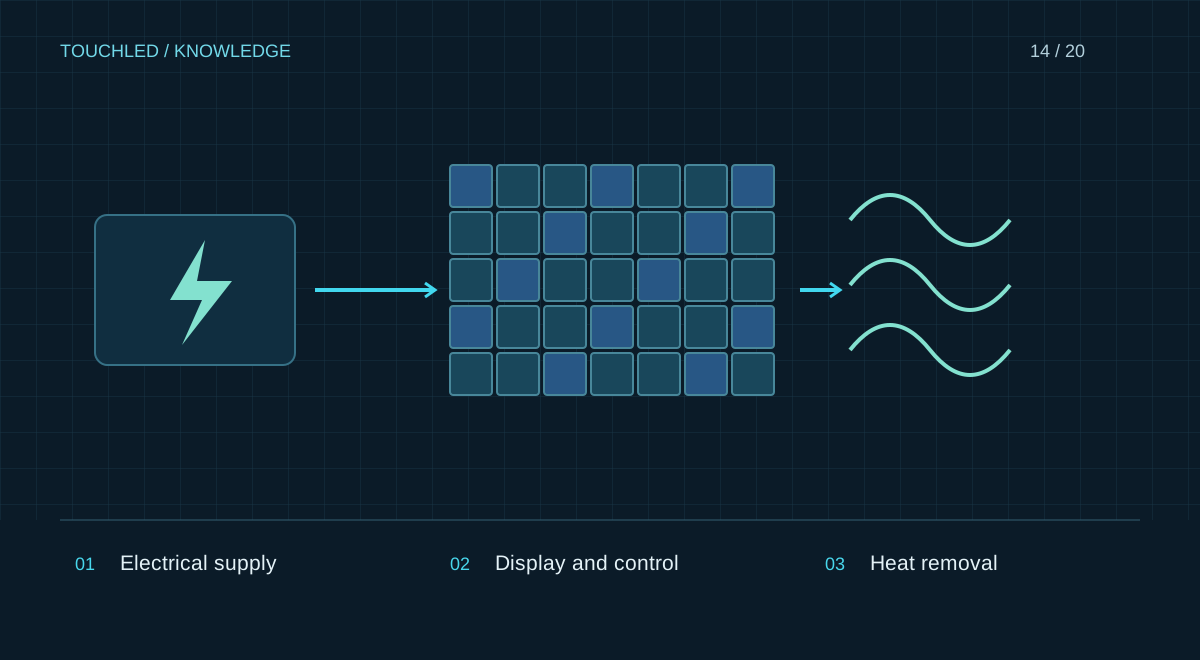
Distinguish maximum and average power
Electrical design needs a confirmed maximum for the selected configuration and its test conditions. Average power depends on content, brightness, mode and operating hours. A typical value from another project cannot support a promise about running costs.
Clarify whether the specification covers only the display or also the controller, player and auxiliary equipment. A supply's rating describes the supply itself, not the actual consumption of a complete cabinet.
Energy calculation example
If measured system average power is 1.2 kW and operation is 10 hours per day for 30 days, energy use is 1.2 × 10 × 30 = 360 kWh. Multiply by the site's tariff to estimate energy cost. This is a teaching example; power and tariff must come from your project.
This calculation does not select a breaker, cable size or circuit rating. Those decisions require site conditions and an electrical specialist.
Cooling concerns the complete installation
Check ambient temperature limits, airflow direction, supply mounting and temperature derating in the exact variant's documentation. A decorative enclosure may block airflow even if the cabinet itself is ventilated.
Provide equipment heat data and operating schedules to the HVAC designer. An arbitrary gap or household fan is not a universal solution. Check temperatures after the system reaches operating conditions with agreed test content.
What to hand over to design and operations
Prepare inputs and agree responsibilities before installation. A qualified specialist handles supply, protection and earthing; this is a project-input checklist, not a wiring procedure.
| Input | Purpose |
|---|---|
| Exact equipment and maximum power | Electrical supply design |
| Startup and operating conditions | Documented design decisions |
| Temperature and ventilation requirements | Cooling and enclosure design |
| Schedule and average consumption | Running-cost estimate |
| Isolation procedure | Safe service and incident response |
Practice: a display in a decorative recess
Equipment is selected for the room temperature, but enclosing the recess traps warm air behind the display. Room temperature does not describe the enclosure's conditions. Before fabricating finishes agree air intake and exhaust paths and access for cleaning ventilation areas.
During testing record brightness, content, ambient temperature and measurement locations. Conditions outside documented limits require a revised cooling solution. Merely reducing brightness does not replace an agreed design or validate installation safety.
- Keep designated ventilation areas unobstructed.
- Do not apply one supply's specifications to another.
- Do not size protection from average power.
Before your next step
- Power values refer to the exact configuration
- Average consumption does not replace maximum
- Electrical design is confirmed
- Ventilation includes decorative enclosures
- Operations receives limits and isolation procedures
Sources and applicability
This is an editorial guide, not validation of a particular product configuration. Teaching examples are not TOUCHLED product specifications or prices.
These sources explain technical principles and the models they describe. Check current documentation for the exact variant and firmware: a cited revision is not necessarily the latest or applicable to all equipment.
Found an issue? Email info@touchled.ru with the article title and section.
Apply this to your project
Share dimensions, site photos and the display's purpose. We will identify open questions and discuss the configuration.
Discuss a project