

Specifications need units, operating conditions and scope to be meaningful.
For: Everyone involved in a project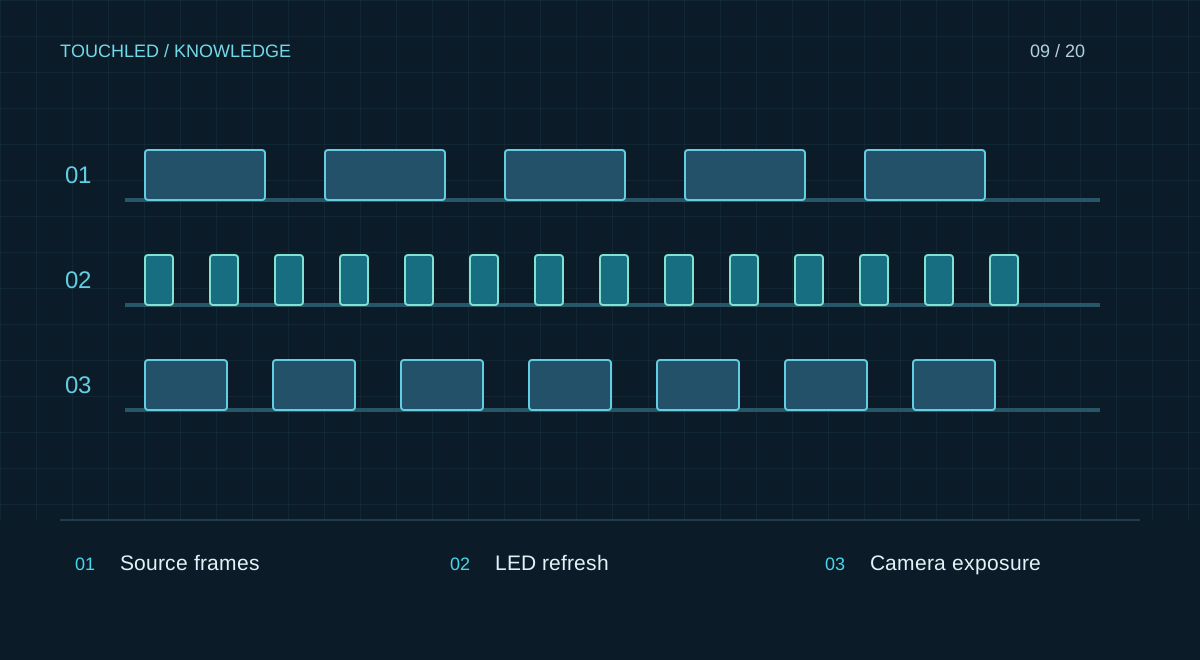
Image
Resolution is image width and height in pixels. Frame rate is video frames per second. LED refresh rate describes display driving and is not the incoming video frame rate. Bit depth describes signal precision; changing it can affect capacity.
Devices and modes
A sending card creates a stream for the LED system. A receiving card converts it for modules. A video processor scales or composes images within its capabilities. Bypass and conversion modes have separate limits; check the mode name against the manual.
Reliability
Redundancy can cover sources, devices, outputs, links or receiving cards. A second connector does not automatically provide it. Genlock coordinates timing between supported devices. Feature support does not guarantee compatibility of every equipment combination.
Frequently confused terms
When reading a datasheet, record not only the value but the system element it describes. A marketing mode name is not a compatibility criterion.
| Term | Meaning | What it does not establish |
|---|---|---|
| Pitch, mm | Distance between pixel centres | Guaranteed text viewing distance |
| Brightness, cd/m² | Surface luminance in a stated mode | Readability under any lighting |
| 4K input | Supported input signal format | A physical 4K display matrix |
| Bit depth | Precision at a particular signal stage | Equal precision throughout the chain |
| Genlock | Timing synchronization | No moiré on any camera |
| Front service | Service from the front | Access to every part without clearance |
Read datasheet notes
Find the document revision, date, limit tables and footnotes. Check whether additional cards, licences or specific firmware are required. Compare devices in equivalent modes: advertised maxima can apply to different conditions and may not be available simultaneously.
Practice: questions behind a 4K claim
Break a 4K claim into input format, internal processing, output capacity and physical display resolution. A controller may accept one format and scale it onto a smaller matrix. That can be appropriate but does not make the physical display 4K.
Likewise, a 16-bit claim needs a signal stage and operating mode. Specify pixel dimensions, frame rate and the stated signal precision instead of relying on a short marketing label.
- Pixels and millimetres are not interchangeable.
- Refresh hertz and frames per second describe different processes.
- Device-wide and per-port capacity require separate checks.
Before your next step
- Every value has a unit
- System inputs and outputs are distinguished
- Operating mode is recorded
- Footnotes and limits are read
- Conditions are equivalent when comparing
Sources and applicability
This is an editorial guide, not validation of a particular product configuration. Teaching examples are not TOUCHLED product specifications or prices.
These sources explain technical principles and the models they describe. Check current documentation for the exact variant and firmware: a cited revision is not necessarily the latest or applicable to all equipment.
Found an issue? Email info@touchled.ru with the article title and section.
Apply this to your project
Share dimensions, site photos and the display's purpose. We will identify open questions and discuss the configuration.
Discuss a project