

A useful brief defines outcomes and constraints and turns unknowns into specific questions.
For: Owners and project managers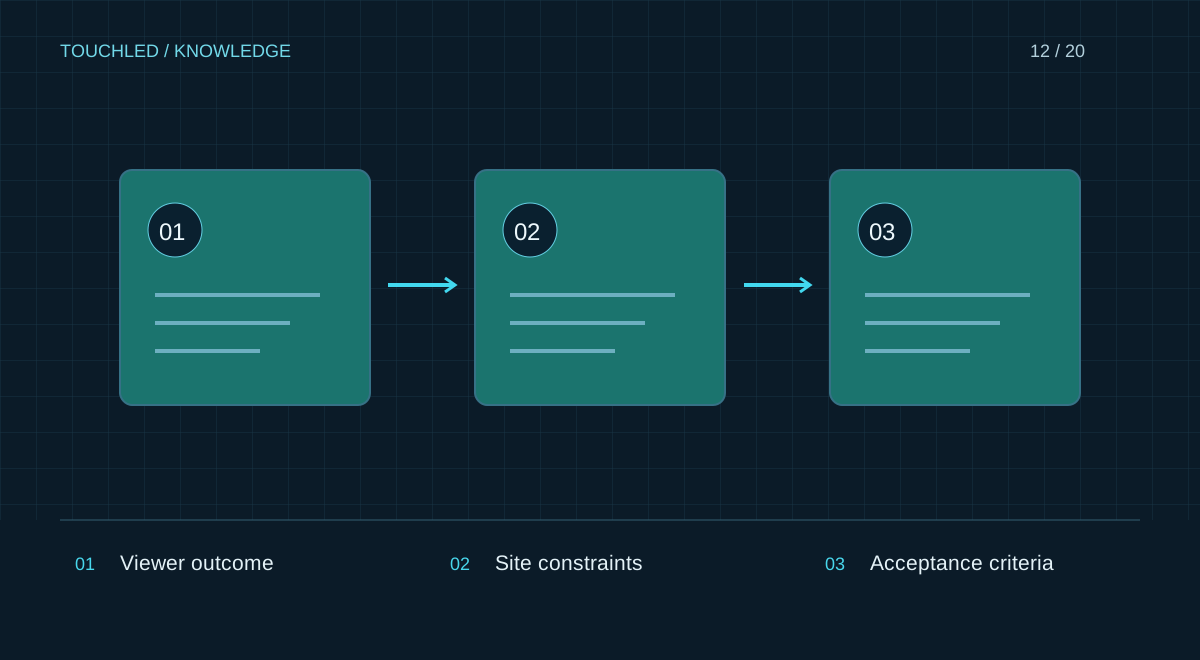
Start with the viewer's outcome
Describe the main task: reading meeting-room slides, seeing a live stage feed or noticing lobby advertising. Identify viewers, positions, viewing duration and content ownership. ‘A large high-quality display’ is not a measurable outcome; a real slide or video is more useful.
Assign a requirements owner. Design covers placement, IT covers sources and networking, and operations covers access and schedules. Resolve disagreements before selecting pixel pitch.
Minimum design inputs
Mark unknowns as requiring a survey and separate preferences from hard constraints. A preferred 16:9 format may be less important than the available wall height. Final dimensions follow cabinet increments.
| Section | Record |
|---|---|
| Purpose | Audience, content, readability criterion |
| Location | Photos, dimensions, light, distances |
| Sources | Laptops, cameras, player, inputs |
| Operation | Hours, schedule, operator |
| Site | Power, network, structure, access |
| Project | Budget range, deadlines, work boundaries |
Define acceptance criteria early
Agree the content shown at handover, viewing positions and sources to switch. Include drawings, configuration backups and training. Filming requires a test with the specific camera and mode; a high datasheet refresh rate does not replace it.
Control brief revisions
Save revision number and date, an owner for each open question and its due date. Request a revised configuration when dimensions, purpose or sources change. Compare quotes against the same brief version. Exclude passwords, access tokens and information unnecessary for selection.
Practice: separate mandatory and preferred requirements
For a lobby display, the customer specifies mandatory pedestrian clearance, a preferred width and advertising playback without a permanent computer. Clearance is a site constraint, width is a selection variable, and autonomy is a functional requirement. One screen-size field cannot replace them.
Ask the supplier to explain any departures from preferences and their effect on the task. Deviations from mandatory requirements need explicit agreement, with the final set recorded before ordering.
- Preferences need priorities; constraints need a basis.
- Unknown values need a confirmation method.
- Acceptance criteria must be observable.
Before your next step
- A requirements owner is assigned
- Photos and content samples are available
- Preferences are separated from constraints
- Open questions have owners
- Handover documents and acceptance are defined
Sources and applicability
This is an editorial guide, not validation of a particular product configuration. Teaching examples are not TOUCHLED product specifications or prices.
The checklists and templates are TOUCHLED editorial guidance. Supply scope, commercial terms and acceptance criteria belong in the individual project's documents.
Found an issue? Email info@touchled.ru with the article title and section.
Apply this to your project
Share dimensions, site photos and the display's purpose. We will identify open questions and discuss the configuration.
Discuss a project