

Total capacity is one check. Geometry, operating mode and per-output calculations are also required.
For: Designers and integrators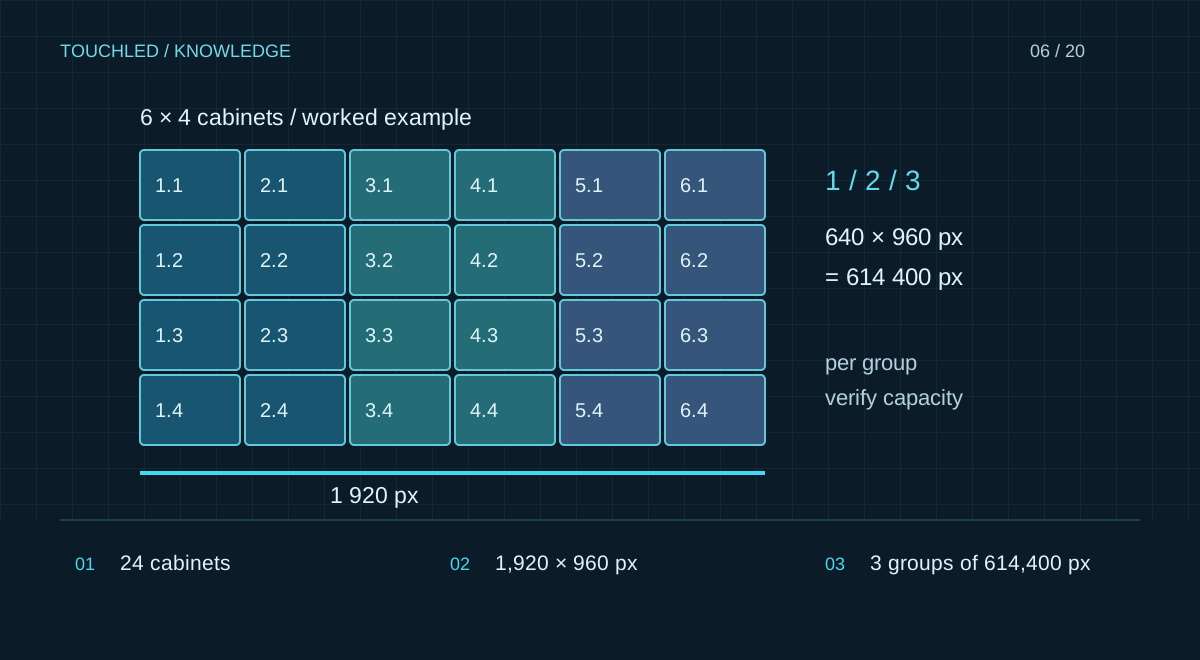
Calculate from the module
Training example: a 320×160 mm module contains 64×32 pixels. A canvas of 10 modules horizontally and 6 vertically measures 3200×960 mm and 640×192 pixels, or 122,880 pixels. This is synthetic, not a TOUCHLED product specification. Use the module’s exact resolution, not rounded pixel pitch.
Check the distribution
After total pixels, check every receiving card and controller output. Width and height limits apply alongside area limits. Multiplying maximum width by maximum height does not establish an allowed load.
The operating mode changes the result
Frame rate, bit depth, 3D and routing can change capacity. Some modes count actual cabinets; others count a bounding rectangle. Redundancy requires a separate layout. A result without a connection layout and operating conditions remains preliminary.
Worked cabinet example
Suppose a 640 × 480 mm cabinet contains 320 × 240 pixels and the wall has 6 × 4 cabinets. Dimensions are 3,840 × 1,920 mm. Resolution is (6 × 320) × (4 × 240) = 1,920 × 960 pixels, or 1,843,200 pixels total. These are hypothetical values, not a catalogue product.
If four equal vertical groups are possible, each receives 480 × 960 = 460,800 pixels. However, this boundary can cross a cabinet, so the chosen addressing must support it. Dividing the total by the number of ports does not itself produce a valid layout.
What the load sheet must check
Enter manual limits for the selected bit depth and frame rate. Separately check receiving-card capacity and module connections. Spare total pixel capacity cannot compensate for excessive width, height or data-group count.
| Level | Check |
|---|---|
| Geometry | Integer modules and cabinets, no rounding |
| Controller | Total capacity, width, height and mode |
| Each output | Pixel load and individual port constraints |
| Receiving card | Matrix, driver, scanning and interface |
Practice: dividing along cabinet boundaries
For the example wall of 6 × 4 cabinets, each 320 × 240 pixels, consider three vertical groups two cabinets wide. Each group contains 640 × 960 = 614,400 pixels; all three total 1,843,200. Boundaries lie between cabinets.
This validates arithmetic and geometry, not a controller choice. The actual system must still support 614,400 pixels per output, group dimensions, signal mode and routing. If capacity is insufficient, revise the layout rather than rounding the load down.
- Group loads must total the display matrix.
- Use whole cabinets or documented internal divisions.
- Recheck capacity after changing bit depth.
Before your next step
- Exact matrix is used instead of rounded pitch
- Layout fits equipment increments
- Every output is checked in the operating mode
- Backup is not counted as extra capacity
- Inputs and calculation revision are saved
Sources and applicability
This is an editorial guide, not validation of a particular product configuration. Teaching examples are not TOUCHLED product specifications or prices.
These sources explain technical principles and the models they describe. Check current documentation for the exact variant and firmware: a cited revision is not necessarily the latest or applicable to all equipment.
Found an issue? Email info@touchled.ru with the article title and section.
Apply this to your project
Share dimensions, site photos and the display's purpose. We will identify open questions and discuss the configuration.
Discuss a project